CHAPTER 01October 11, 2023
An early creative precursor
Themed mantra and password experiments in Colab explored the creative territory. This was an earlier exploration; a direct code lineage to Magic8 has not been established.
From a shake-the-ball password idea to an Android vault and Autofill preview. This is the story of building Magic8 Pass—and learning what it takes to make the magic dependable.
Explore the development story ↘Magic8 began with a simple possibility: make generating a password feel more engaging. Themes, complexity controls, and a shake-the-ball interaction gave the experiment its personality.
The harder questions arrived with use. Where does a secret come from? How is it stored? Can it reach the right field, in the right browser, at the right moment? Those questions reshaped the project into a focused Android workflow: generate, save, unlock, and fill.
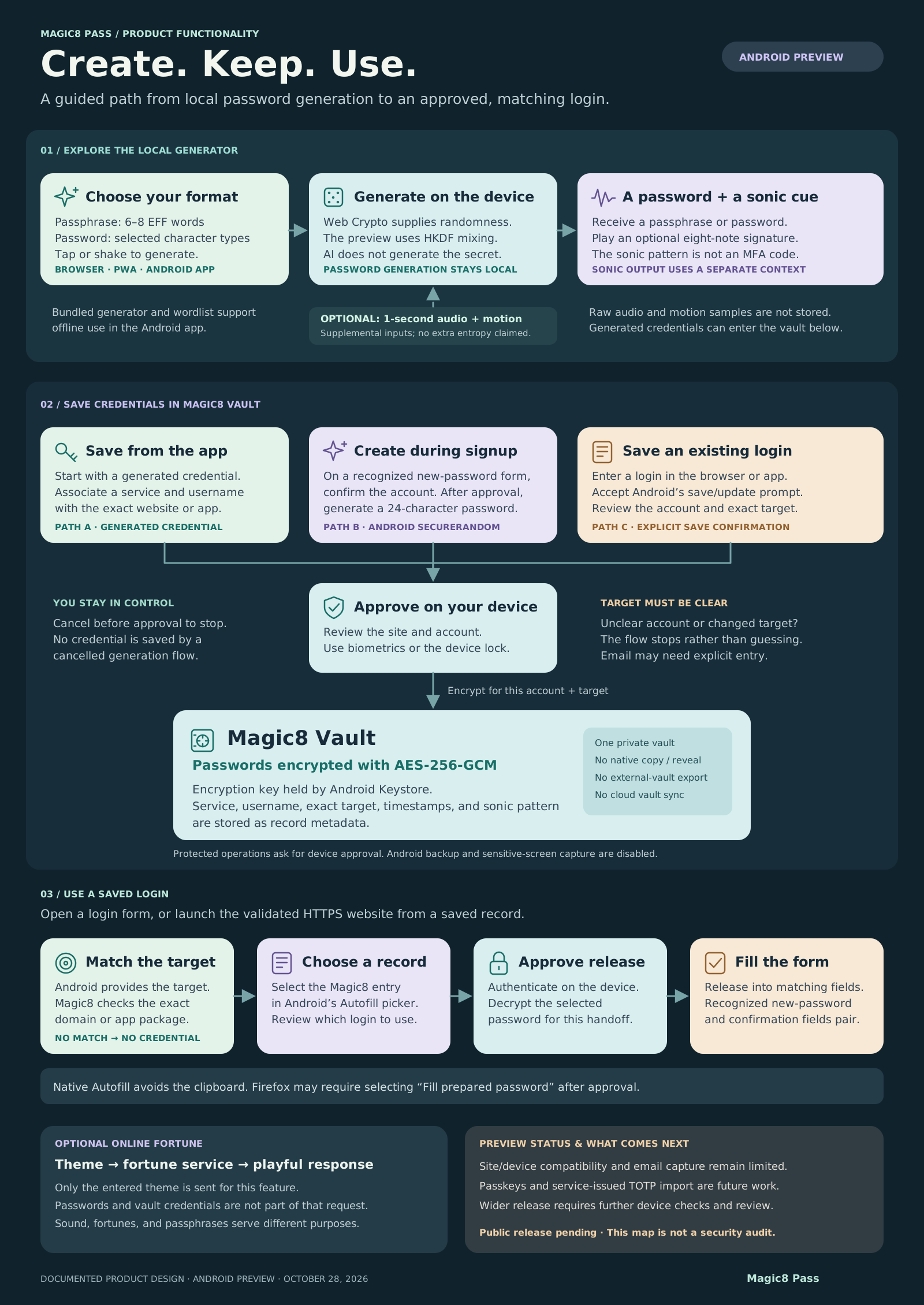
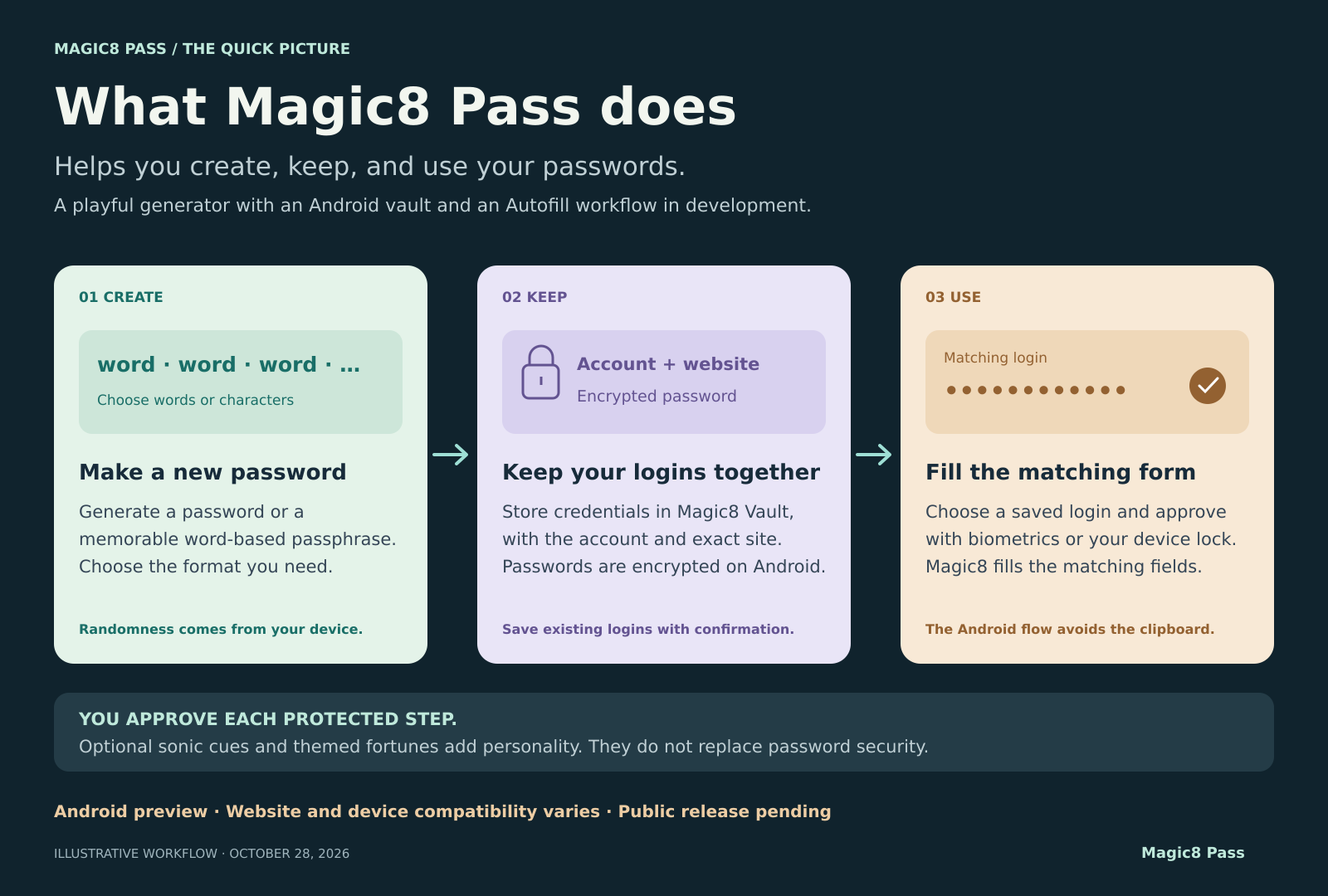
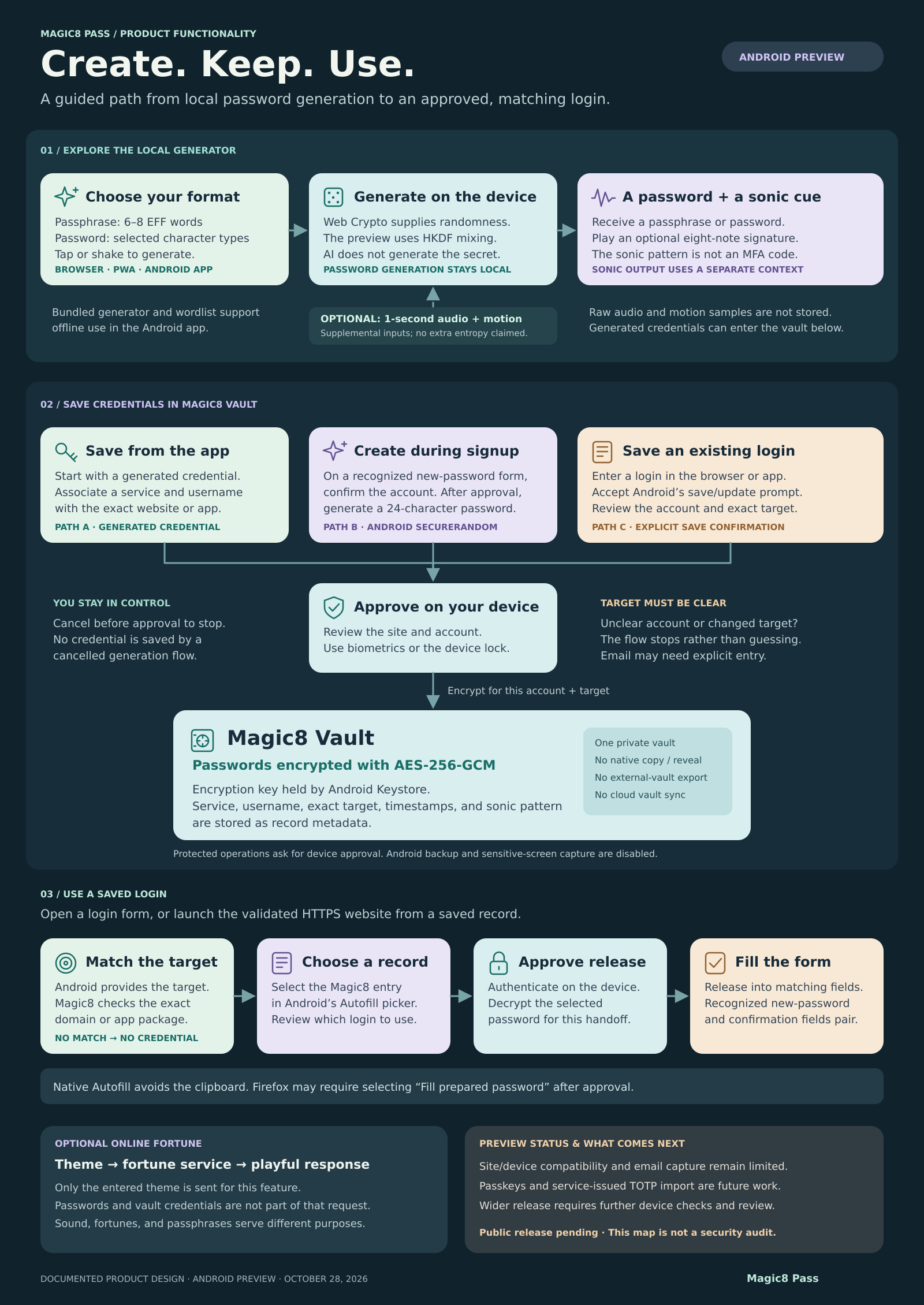
Create a password, keep it in your Android vault, and fill a matching login after you approve. These visual guides explain the product and its preview workflow.
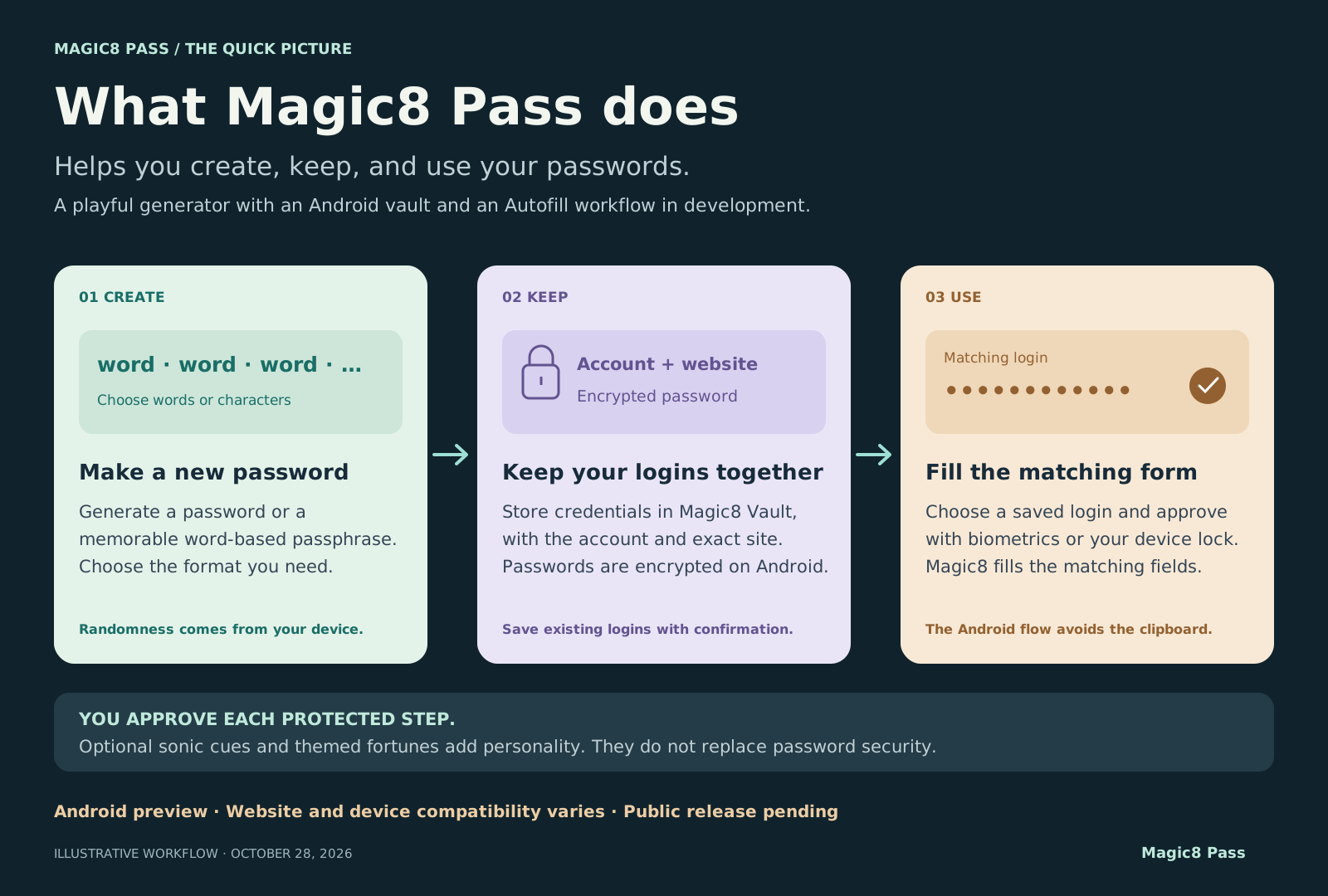
See both generation paths, the three ways to save credentials, device approval, vault protection, exact-site matching, and the optional sound and fortune features.
Explore the detailed diagram →A chronology reconstructed from the development record. Historical milestones describe what was observed at the time; they are not a claim of current release readiness.
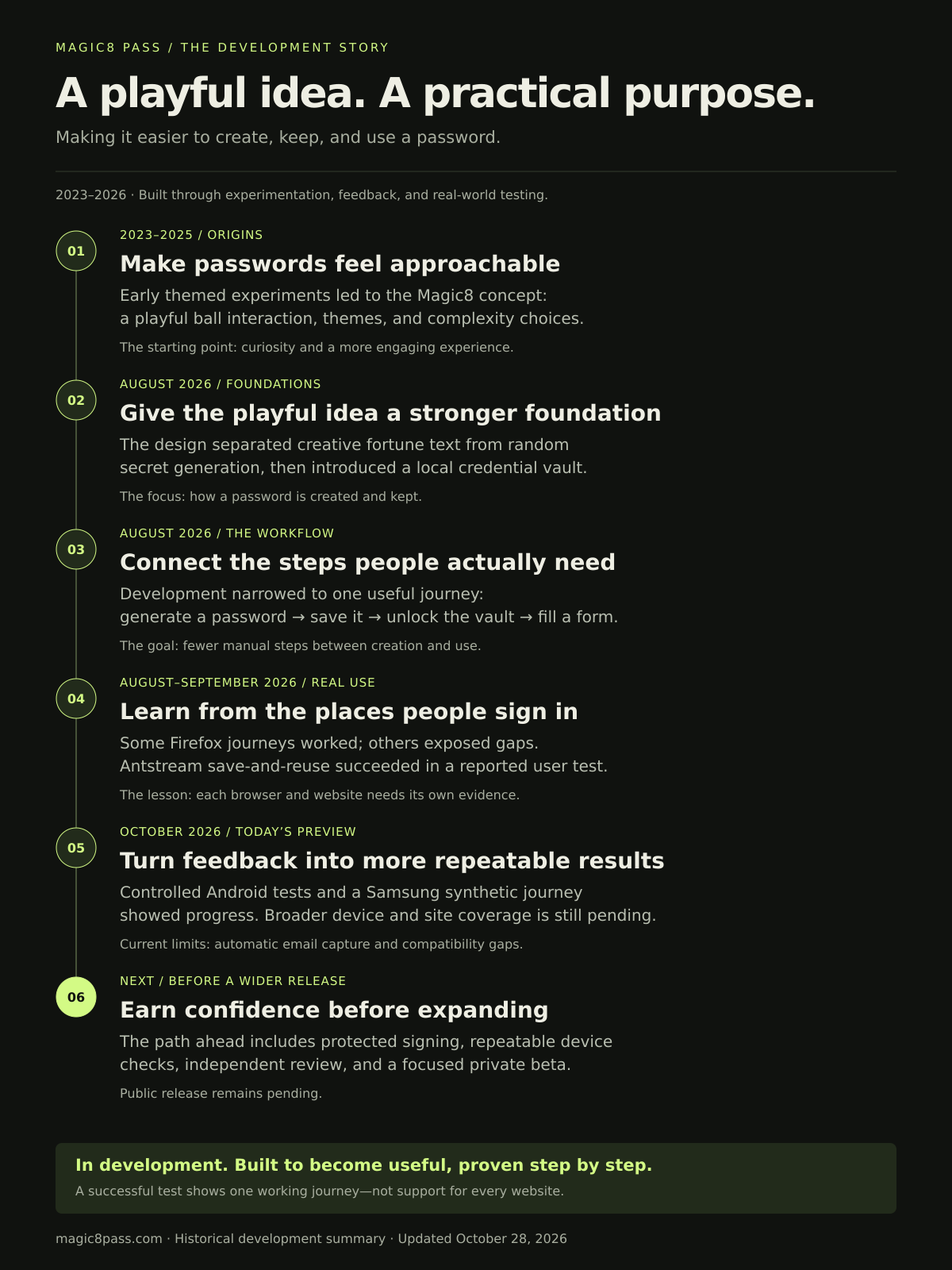
Themed mantra and password experiments in Colab explored the creative territory. This was an earlier exploration; a direct code lineage to Magic8 has not been established.
An Android and language-model idea brought together themes, complexity controls, and the shake-the-ball interaction. An HTML / Netlify phone prototype generated random output, while theme and readability experiments struggled. Language-model integration stopped at an API error.
The design separated AI fortune text from Web Crypto random secrets. EFF word-list passphrases of six to eight words became part of the direction. The accepted behavior and reported pull-request merge marked a shift toward a more explicit security model.
Capacitor and PWA work introduced credential saving, but delivery back to the browser failed. Audio, motion, sonic fingerprint, and TOTP ideas were explored as experiments; these did not establish a production MFA system.
The project focused on a concrete path: generate → Magic8 Vault → Magic8 Autofill → matching form. Sharing and external-vault paths were removed from scope.
Early reports included Firefox Autofill success, work on new-password and confirmation fields, and a successful Warmind flow. Shopify still failed. Compatibility became a site-by-site problem requiring direct observation.
Stabilizing Test 22 became more useful than repeatedly changing build numbers. A regression harness and controlled checks helped reproduce failures. A reported Shopify success was corrected to a failure—a reminder that a green test and a filled field are different evidence.
A user-reported Firefox flow created an Antstream account, saved credentials, and used the saved vault credentials for a fresh login. This demonstrated a specific save-and-reuse journey; it did not prove every generated-password signup flow.
Controlled Test 107 checks passed while the expected popup was absent on the user’s device. The direction shifted toward a personal beta, with repeatable physical-device results still required.
Mac mini development, an isolated AuthCheck flow, and emulator journeys supplied more controlled evidence. Wireless ADB testing recorded a Samsung synthetic end-to-end pass. That flow used an explicit email; automatic email capture remained unavailable.
The development record describes a critical dependency-advisory fix, verified-signer and Firefox-only beta policy work, and vault, backup, and release guards. Device checks continued. The current draft remained unmerged; a public test signer was not a production signer.
Protected signing, device and artifact gates, independent review, and a synthetic private beta remain part of the path forward. Automatic email capture and public release are not complete.
Controlled success is not universal site support. The milestones above preserve that distinction throughout the story.
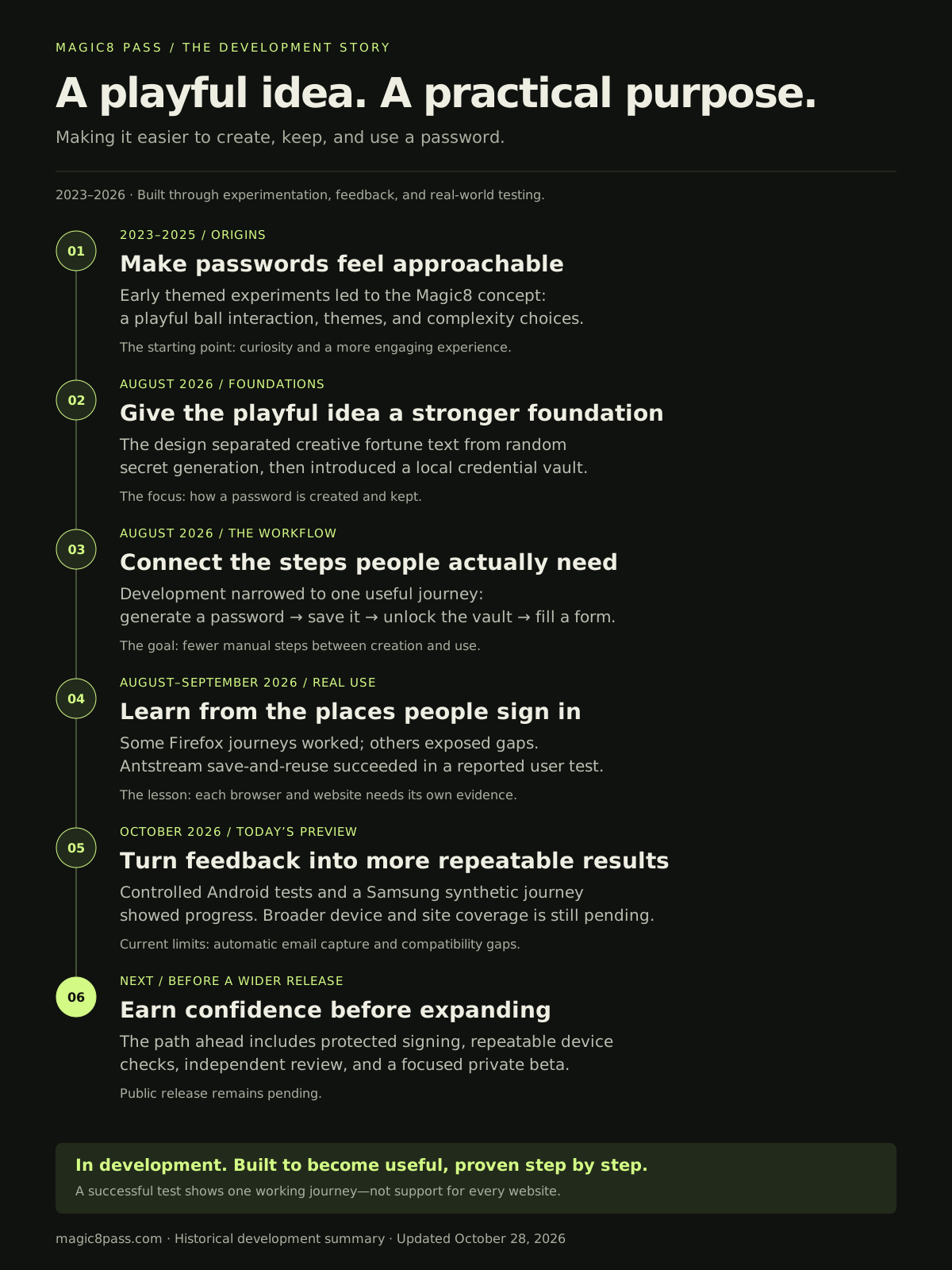
The public story documents progress and its limits. Magic8 Pass remains in development, with no production release offered here.
Questions about the project, ideas for the preview, or feedback on the workflow? Get in touch.
hello@magic8pass.com ↗